November 2026
mySaldoa
My take on Microsoft Money, rebuilt for today: personal finance with honest multi-currency net worth from exchange rates synced daily, a modern interface, and AI that sets up accounts from plain words and reads bills from email.
Why I built it
For me, Microsoft Money was the best personal-finance software ever made — clear, complete, and organized around how people actually think about their money. Microsoft discontinued it in 2009, and nothing since has matched it. Inspired by that work, I built mySaldoa to keep what Money got right and fix what it never handled well: accounts in several currencies, a more flexible, modern interface, and AI that takes the busywork out of keeping your finances up to date. That's how mySaldoa was created.
What it does
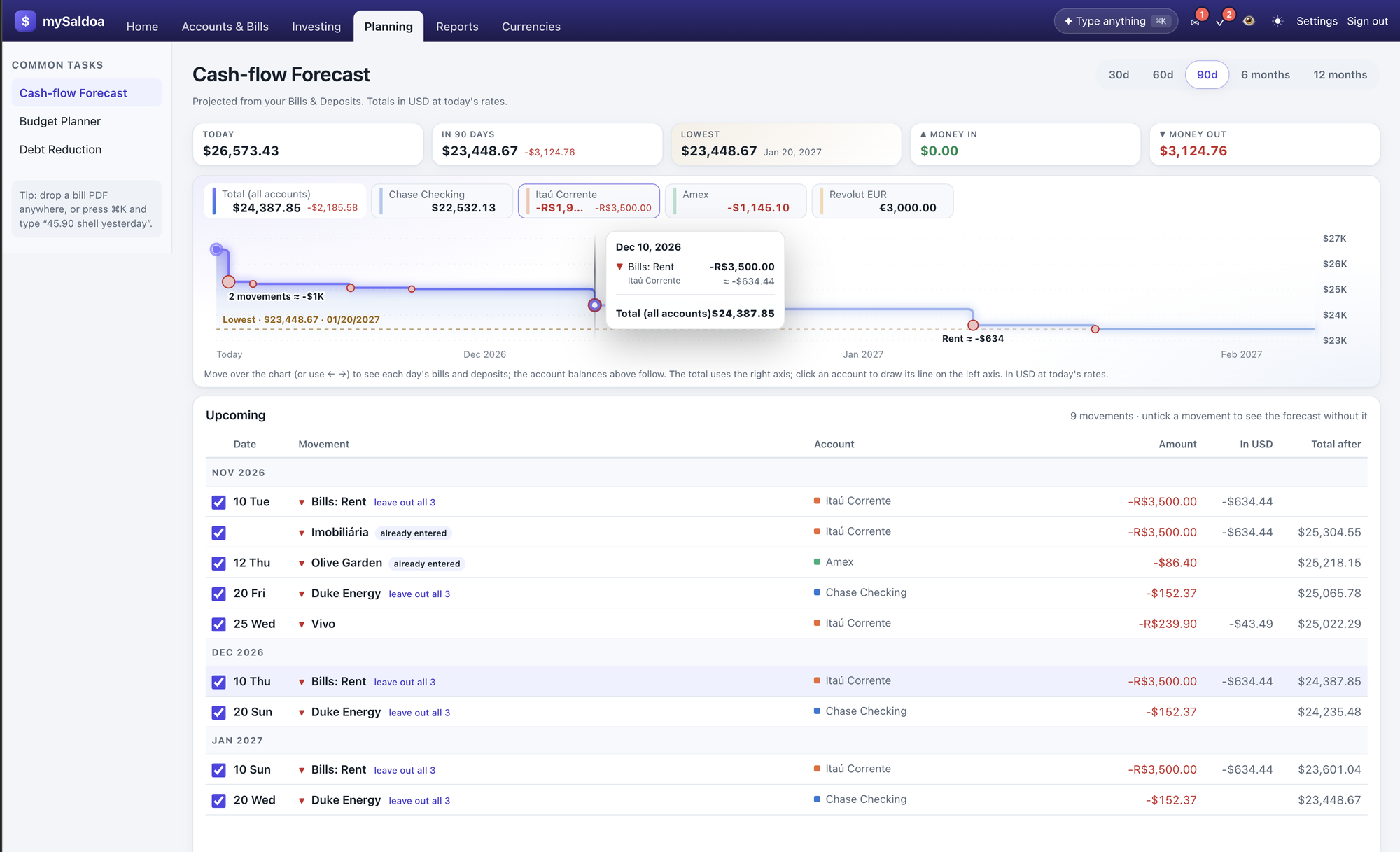
- Money's layout, rebuilt for today — Home, Accounts & Bills, Investing, Planning and Reports, with Money's familiar tools: account registers with splits and transfers, Balance Account, Bills & Deposits, Budget Planner by groups, Debt Reduction, Cash-flow Forecast, and reports and charts.
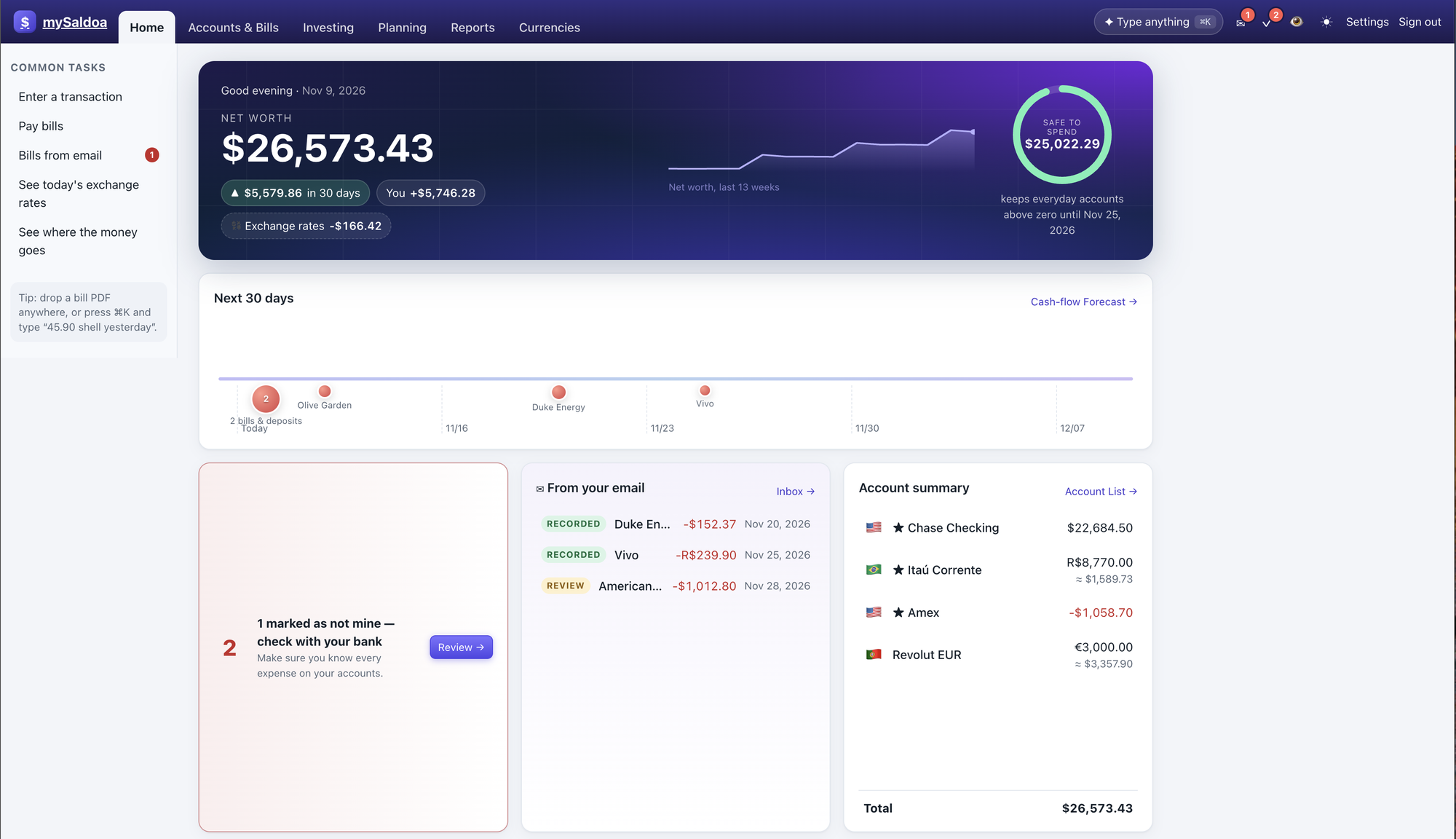
- Honest multi-currency net worth — every account keeps its own currency (including crypto wallets holding several coins); exchange rates sync automatically every day from ECB reference rates, so net worth across countries is real, and you can see how much of a month's change came from exchange rates alone.
- Bring your history with you — import Microsoft Money's own QIF export, OFX, CSV, Excel or Google Sheets, or connect a bank through Plaid. Nothing is reinterpreted: each account keeps the currency it had in Money, and currencies the app doesn't know yet become your own, at the rate Money stored.
- A friendlier interface — a "Type anything" command bar (⌘K) everywhere, a home page that shows what's safe to spend and the next 30 days of bills, sticky headers, charts with their numbers, and English and Portuguese (Brazil).
AI features
- Set up in plain words — describe your accounts the way you'd say them ("Chase checking ending 1234 with about $5,200; Itaú corrente R$ 12.000") and Claude turns that into accounts, currencies and balances.
- Bills read for you — forward a bill, connect Gmail, or drop a PDF or photo; Claude extracts the payee, amount, currency, due date and category (even a Brazilian boleto line), and the bill lands in your Inbox.
- Safe by design — emails are treated as untrusted input: the model has no tools and returns only a schema-validated record, rules work even with AI turned off, and nothing the app records on its own goes unseen until you approve it.
Engineering highlights
- Exact money math — amounts stored as integer minor units; currency conversion runs in SQL with NUMERIC math and a single rounding, and the BigInt version used by the forecast is tested to round identically. Balances are never stored — they're computed over the register.
- Rates you can trust — a daily sync (Cloud Scheduler plus an in-process fallback, advisory lock, chunked fetches with retries), per-user overrides, and a stale-rate warning when a rate is more than four days older than the date it's used for.
- Every feature has a browser test — each user-facing feature has a Playwright spec running on its own fresh database; the deploy script stops on any red test.
Stack
React 18 · TypeScript · Vite · Node.js · Express · PostgreSQL · zod · Anthropic Claude (structured outputs) · Plaid · Postmark Inbound · Gmail API · Firebase Auth · Firebase Hosting · Google Cloud Run · Cloud Scheduler · Playwright · Terraform